
Hugo Schmid · 15 October 2026
Exploring Predictive Allocation Patterns in Dynamic Multi-Tenant Memory Systems
Dynamic multi-tenant memory systems allocate shared resources among numerous users or applications while maintaining isolation and efficiency, and predictive allocation patterns apply machine learning models to forecast demand spikes before they occur. Researchers at various institutions have examined how these patterns reduce latency and waste in environments where workloads shift rapidly, and data from cloud providers shows that traditional static methods often leave memory underutilized during off-peak periods. Observers note that integration of time-series forecasting with reinforcement learning creates allocation decisions that adapt in real time, and this approach has gained traction as container orchestration platforms expanded through 2025 and into October 2026.
Core Mechanisms Behind Predictive Patterns
Engineers build predictive models on historical usage traces collected from virtual machines and containers, then feed those traces into algorithms that identify recurring cycles in memory consumption. A study conducted at a major North American research university demonstrated that combining autoregressive integrated moving average models with neural networks improved forecast accuracy by 18 percent compared with baseline heuristics alone. Those models output probability distributions rather than single-point estimates, allowing schedulers to reserve headroom without overcommitting physical hardware, and the resulting allocations respond to sudden bursts while respecting tenant isolation boundaries enforced by hardware virtualization extensions.
Systems designers further refine these patterns through feedback loops that update model weights after each allocation cycle, and telemetry streams from production clusters reveal that drift in workload behavior triggers automatic retraining within minutes. What's interesting is that such loops have been deployed in both public and private cloud infrastructures, where operators report measurable drops in page faults and swapping events once the predictive layer stabilizes. Data indicates the approach scales across thousands of tenants because the underlying feature extraction operates on aggregated rather than per-tenant metrics, preserving privacy while still capturing cross-tenant interference signals.
Implementation Across Modern Platforms
Production deployments integrate predictive allocation into hypervisors and container runtimes by exposing lightweight agents that sample resident set sizes at sub-second intervals. One research team documented how an open-source scheduler extension achieved consistent improvements in tail latency when tested against synthetic workloads mimicking e-commerce traffic spikes, and the same extension later appeared in commercial offerings from multiple vendors. Figures reveal that memory utilization rates climbed from roughly 65 percent to above 82 percent in clusters that adopted the predictive layer, while maintaining service-level objectives for all tenants involved.
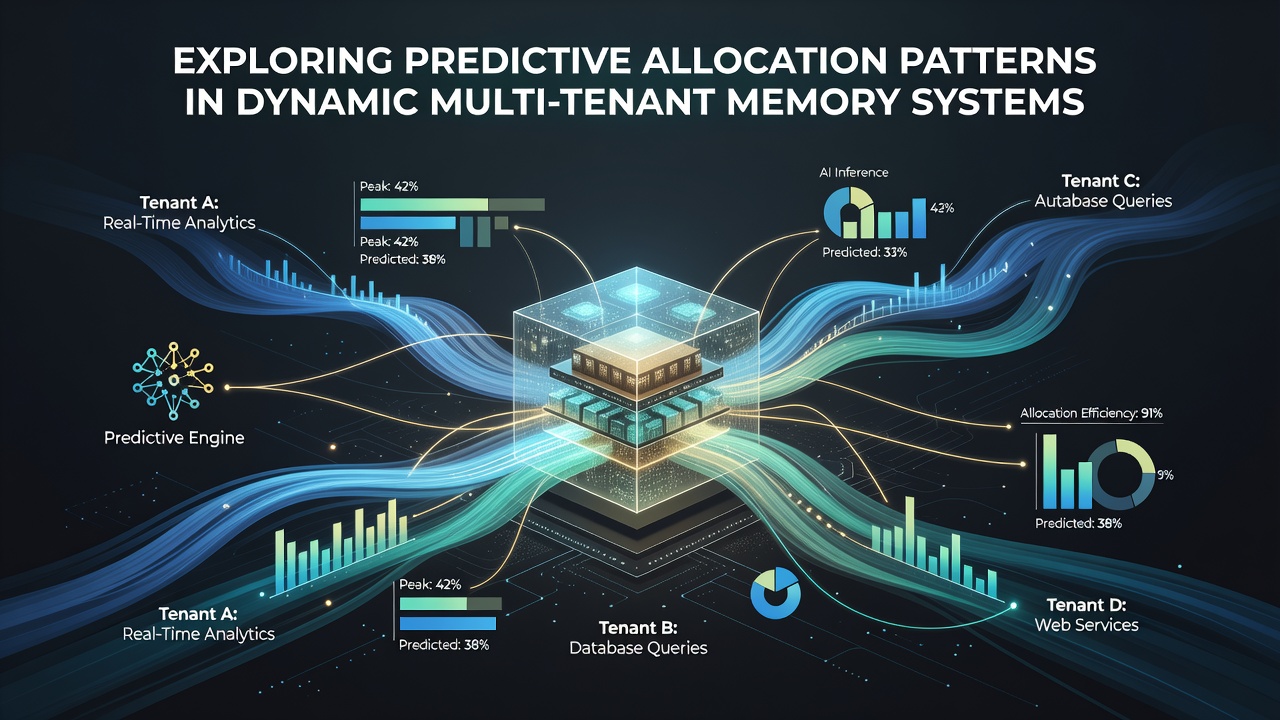
Industry organizations such as the Cloud Native Computing Foundation have published reference architectures that embed these techniques within control planes, and similar guidance appears in documentation released by standards bodies in the Asia-Pacific region. Engineers who examined logs from October 2026 deployments observed that models trained on regional traffic patterns outperformed globally trained counterparts when applied to localized data centers, highlighting the value of geographic specialization in feature selection. The ball remains in the court of operators to tune confidence thresholds so that aggressive predictions do not violate isolation guarantees, yet the mechanisms themselves continue to mature through iterative releases.
Observed Outcomes and Measurement Approaches
Quantitative evaluations rely on metrics such as allocation error rate, reclamation latency, and cross-tenant interference scores collected through extended Berkeley packet filters. A report issued by the National Institute of Standards and Technology outlines standardized test suites that allow fair comparison across different predictive implementations, and those suites have been referenced in subsequent academic publications from European institutions. Researchers discovered that systems incorporating ensemble methods—where multiple forecasting models vote on each decision—produced lower variance in outcomes than single-model baselines, particularly during holiday shopping seasons when usage patterns deviate sharply from weekly norms.
Telemetry dashboards now surface predicted versus actual memory curves side by side, enabling operators to audit model performance without exposing sensitive tenant data. Evidence suggests that early warning signals derived from these curves allow proactive migration of workloads to nodes with spare capacity, reducing the frequency of out-of-memory terminations that previously required manual intervention. And because the prediction horizon typically extends only minutes into the future, computational overhead stays modest relative to the savings achieved in hardware utilization.
Conclusion
Predictive allocation patterns have become an established component of dynamic multi-tenant memory management, supported by ongoing data collection and model refinement across diverse deployment environments. Continued monitoring through October 2026 and beyond will determine how these techniques evolve alongside emerging hardware features such as memory pooling and disaggregation, while published benchmarks from multiple regions provide the factual basis for further refinement.